
Agriculture
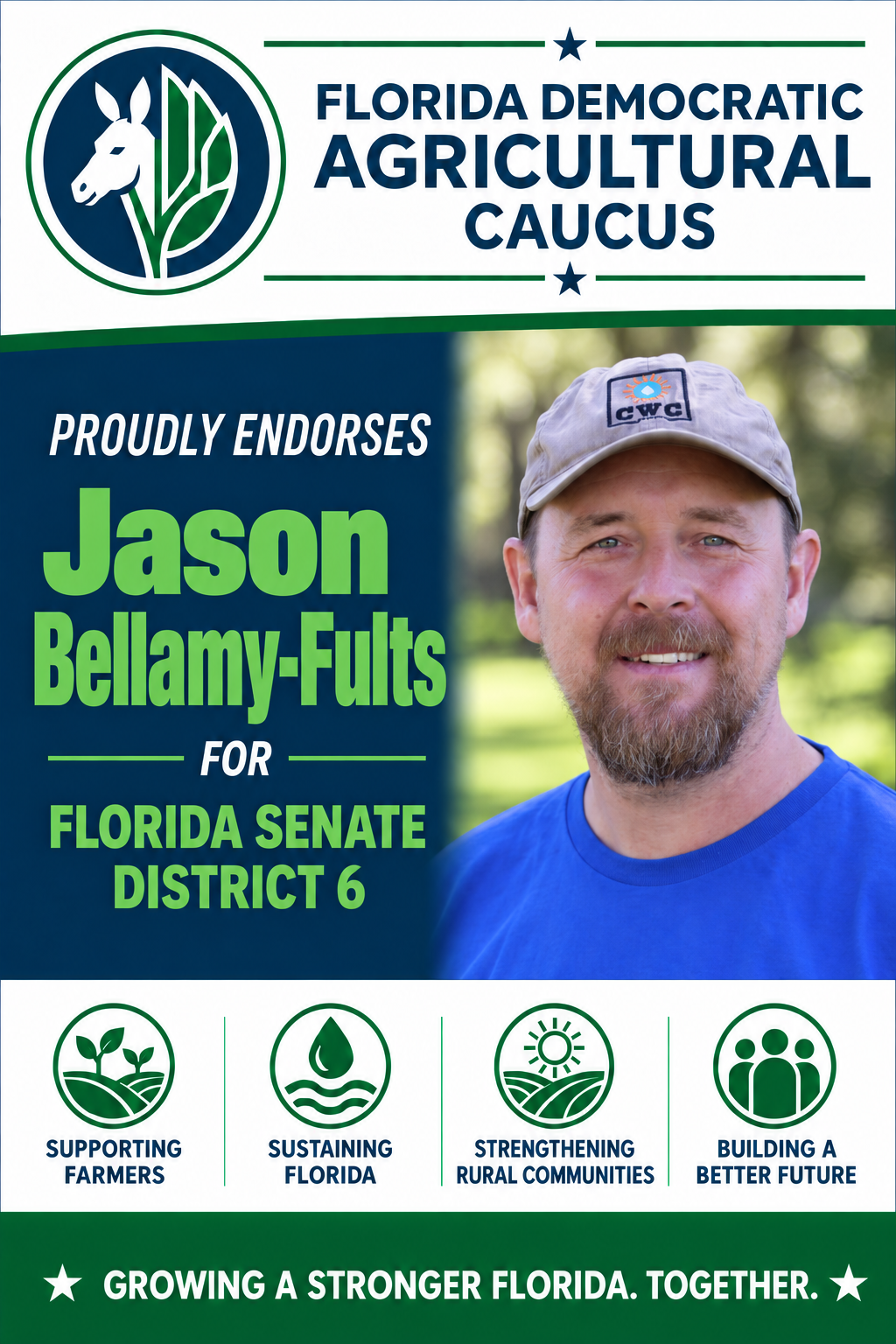
Jason has been endorsed by the Florida Democratic Agricultural Caucus and supports their grounded, thoughtful platform for Florida’s agricultural communities.
-
Florida plays a special role in U.S. food security because we can grow a remarkably diverse mix of food and agricultural products, including during seasons when much of the country cannot. That makes protecting Florida agriculture more than a matter of preserving an industry. It is part of maintaining a resilient domestic food supply.
The challenge is that Florida is also growing rapidly. Housing, roads, warehouses, and other development are necessary, but every acre of productive farmland converted to development is nearly impossible to recover. We should therefore steer growth toward existing communities and infrastructure wherever practical while giving farmers realistic alternatives to selling their land for development. Programs such as working-land conservation easements can help landowners realize some of the value of their property while keeping it in production.
Keeping land in agriculture is only part of the solution. Farms also need reliable water, labor, markets, transportation, processing capacity, insurance, disaster recovery, research, and protection from invasive pests and diseases. We also need to make it easier for younger farmers to enter agriculture and for established farmers to transfer viable operations to the next generation.
Perhaps the greatest long-term threat to Florida’s ability to contribute to U.S. food security is severe weather driven by abrupt climate change. The intense winds and rains associated with extreme weather can and have devastated crops throughout our state. Harsh droughts beyond those previously experienced can have a similarly destructive impact. While climate is a larger national and global crisis, agriculture can and must contribute to solutions through emissions reduction and carbon sequestration into our soils and products.
Our goal should be a Florida in which population growth and agriculture can coexist for decades, even centuries. Food security means more than producing a lot of food this year. It means maintaining the land, water, climate, people, knowledge, infrastructure, and profitable farm businesses needed to keep producing food decades from now. Public programs intended to protect that capacity should be evaluated by whether they actually keep productive land in agriculture, strengthen farm viability, and improve the resilience of our food system.e
-
Florida agriculture needs both large, efficient agricultural businesses and a healthy population of small, mid-sized, family, and beginning farms. These are not mutually exclusive goals. Large operations provide processing, logistics, employment, market access, and economies of scale. Smaller and family farms contribute local ownership, innovation, community stability, diversified production, and an important pathway for the next generation to enter agriculture.
Large farms (those with more than $1 million in annual agricultural sales revenue) constitute only 4% of all Florida farms, but 82% of all agricultural sales in Florida. Small farms are the reverse. Small farms (those with annual sales less than $100,000 per year) constitute 86% of all Florida farms, but less than 4% of all annual agricultural sales in Florida. Annual sales for most of these small farmers are actually below $50,000.
The problem is that smaller farms often face disadvantages that have little to do with how well they farm. Land prices, access to credit, insurance, processing, marketing, technical assistance, and succession costs can all push a viable family toward selling land for development. Public policy should help correct those structural disadvantages through affordable credit, shared processing and cooperative opportunities, institutional and local purchasing, succession planning, beginning-farmer programs, Extension assistance, and adequately funded conservation-easement programs.
At the same time, public support should come with reasonable expectations. If taxpayers provide unusually favorable loans, grants, tax benefits, or conservation payments for the purpose of keeping land in agriculture, we should be able to demonstrate that the program actually serves that purpose. Benefits can be tied to continued agricultural use, conservation commitments, or other measurable public benefits, with safeguards for circumstances outside a farmer's control.
Large agricultural businesses should also have access to research, infrastructure, biosecurity programs, markets, and assistance with environmental modernization, but public support should not simply become an entitlement based on size or political influence. The basic FDAC philosophy should be to help every scale of agriculture remain productive and competitive and also rapidly become environmentally sustainable, while directing scarce public dollars toward measurable public benefits and giving special attention to farms that otherwise lack access to capital and opportunity.
-
Florida agriculture cannot function without a dependable workforce, and a dependable workforce cannot be built on poor treatment of workers. We should stop treating those as competing ideas. Farmers need a legal, predictable labor supply, and farmworkers need fair pay, safe working conditions, decent housing and transportation, and confidence that reporting abuse will not cost them their livelihood.
At the federal level, agricultural visa and immigration programs should be timely, understandable, and predictable enough for producers to plan a season. They also need to reflect the fact that some agricultural operations are seasonal while others require labor throughout the year. At the same time, the protections already attached to programs such as H-2A need to be enforced. A legal labor program loses legitimacy if workers can be cheated on wages, housed unsafely, transported dangerously, or threatened for asserting their rights.
Florida should also address the hazards that are especially important in agriculture: extreme heat, pesticide exposure, field sanitation, transportation, and substandard housing. Trusted worker education and complaint systems can often solve problems before they become crises. Programs such as the Fair Food Program also show that growers, workers, and major buyers can sometimes create market-based systems that improve conditions while rewarding responsible producers.
Finally, labor policy should include productivity. Mechanization, precision agriculture, better tools, training, and apprenticeships can make jobs safer and help farms produce more with a constrained workforce. If public money helps purchase labor-saving technology, we should measure whether it actually improves productivity, safety, wages, or farm viability. The long-term objective is straightforward: Florida should have a farm labor system in which producers can reliably find workers and workers can reasonably expect to be treated as valued participants in the agricultural economy.
-
Florida's climate, international trade, tourism, and enormous movement of people and goods make us unusually vulnerable to invasive pests and diseases. Citrus greening is a painful reminder that a biological invasion can damage not just individual farms but an entire agricultural sector. For that reason, biosecurity should be treated as permanent infrastructure rather than something we fund only after a crisis appears.
The first priority should be prevention and early detection, because stopping a pest before it becomes established is generally far less expensive than living with it forever. That means strong, risk-based inspection at ports, airports, nurseries, cargo facilities, and other pathways; good surveillance in agricultural regions; diagnostic capacity; and easy ways for farmers, farmworkers, Extension agents, and the public to report something unusual.
When a serious new threat is found, Florida needs the ability to move quickly with trace-back investigations, delimiting surveys, quarantine, sanitation, and eradication when eradication is technically realistic. Farmers should not be financially ruined for cooperating with a government-ordered destruction or quarantine program, so compensation and recovery assistance should be part of the response.
Once a pest or disease is established, the emphasis should shift toward integrated pest management: resistant varieties and rootstocks, conventional breeding and biotechnology where scientifically justified, carefully tested biological controls, improved cultural practices, precision treatment, and responsible chemical controls when necessary.
This is also a good place for pay-for-performance government. We should measure detection time, geographic spread, crop losses avoided, response time, adoption of effective controls, and other meaningful outcomes. Programs that demonstrably reduce risk should be expanded; approaches that repeatedly fail should be changed. Farmers need government to be fast, scientifically competent, and willing to learn.
-
FDAC should reject the idea that Florida must choose between profitable agriculture and aspirations for clean water and reduced greenhouse gas emissions. Farmers need to make money, but polluted water, damaged fisheries, degraded ecosystems, contaminated drinking-water supplies, extreme weather, and unhealthy soils also impose very real economic costs. The sensible goal is to produce more value with less pollution and to help farmers make the transition when better practices require substantial investment.
Florida's agricultural Best Management Practices (often referred to as BMPs) already recognize this balance by considering water quality, agricultural productivity, and economic and technological feasibility. Cost-sharing can be entirely appropriate for irrigation improvements, nutrient-management technology, water retention, soil-health practices, precision application, and other improvements that provide both farm and public benefits. Smaller operations may need a higher percentage of assistance because they have less capital with which to make large improvements.
Voluntary BMPs are not enough. Public support should purchase public performance, not simply equipment. That is where a pay-for-performance philosophy becomes especially important. We should establish a baseline, document that the funded practice was actually installed and operated, and measure environmental outcomes whenever measurement is technically and economically practical. This documentation should happen at the farm and edge of farm scale, not just the watershed scale. Programs should be evaluated by reductions in nutrient losses, water use, soil erosion and subsidence, emissions, or other relevant outcomes rather than by the number of checks written. We also need safeguards against duplicate reimbursement and reasonable clawbacks when recipients misuse funds or fail to carry out agreed obligations.
At the same time, farmers who are meeting higher U.S. environmental and labor standards should not be placed at a needless competitive disadvantage against imports produced under much weaker standards. Procurement, credible labeling, research, transition assistance, and lawful trade policy can help recognize those differences.
The principle is simple: help farmers afford environmental improvement, reward real performance, verify that taxpayers received the benefit they paid for, and keep improving the system as the science and technology improve.
-
Agriculture is one of the sectors most directly exposed to climate change because farmers work with weather every day. In Florida that means increasing heat stress, drought, intense rainfall and flooding, hurricanes, changing pest and disease pressures, saltwater intrusion in some areas, and insurance and financial risks that can follow those physical changes. Climate policy for agriculture therefore needs to address both mitigation and resilience.
There is no single 'climate-smart' practice that fits every Florida farm. Depending on the crop, soil, location, and operation, useful approaches can include improved nutrient management, cover crops, conservation tillage where appropriate, rotational grazing, silvopasture, agroforestry, methane management, more efficient irrigation and pumping, renewable energy, water storage, and technologies that reduce fertilizer and fuel use. Many of these practices can lower costs or make farms more resilient even apart from their climate benefits.
Florida should invest heavily in research and demonstration under our own subtropical conditions. We should not assume that a practice developed for Midwestern corn automatically works in Florida sugarcane, vegetables, citrus, pasture, or sandy soils. UF/IFAS, other universities, Extension, NRCS, water management districts, and farmers themselves should be partners in determining what actually works here.
Public incentives should then help producers adopt proven practices through technical assistance, cost-sharing, financing, and credible markets for environmental services. But climate programs should also follow pay-for-performance principles. Payments for carbon, water storage, nutrient reduction, or resilience should use credible baselines and verification and should reward additional, durable results rather than simply paying for a label or a practice that may not deliver the promised benefit.
This is where new approaches in benefit assessments become critical. The old cost-benefit analysis is no longer enough. Modern approaches such as Life Cycle Assessment and other ecological economics metrics must be applied to agricultural systems assessment.
The objective is not to dictate one technology. It is to help Florida farmers choose and improve systems that measurably reduce risk and emissions while protecting productivity, water, soil, and long-term profitability.
-
Florida agriculture has always depended on science and innovation, and the challenges ahead make that even more important. Citrus greening, invasive pests, water shortages, nutrient pollution, labor constraints, extreme weather, rising production costs, and international competition will not be solved simply by asking farmers to work harder. We need better tools, better plants and animals, better information, and better production systems.
That requires both public and private investment. Governments and universities are especially important for basic science, long-term field research, public data, biosecurity, water management, and other work whose benefits are widely shared and may not generate a quick private return. Private firms are often better positioned to turn discoveries into commercial products and bring them to scale. Extension is the bridge that helps make useful knowledge available to farmers rather than leaving it in laboratories and journals.
Florida should therefore continue strong investment in the traditional agricultural research universities (UF/IFAS, FAMU) as well as other research institutions while also strengthening community colleges, career and technical education, apprenticeships, and continuing education. Priority areas should include greenhouse gas emissions reduction, climate resilience, pest and disease resistance, robotics and mechanization, precision agriculture, water and nutrient efficiency, soil science, controlled-environment agriculture, energy efficiency, remote sensing, AI, and food processing and safety. But supporting the applied sciences is not enough. It is the basic sciences (physics, chemistry, biology, mathematics, and even logic/philosophy in the case of AI) that deliver some of the most critical breakthroughs. They too must be supported.
At the same time, 'innovation' should not become a magic word that excuses waste. Public research programs should have clear objectives and periodic independent evaluation. Early-stage research needs room to fail because failure is part of discovery, but successful programs should be able to show progress toward useful knowledge, technologies, trained workers, environmental improvement, or economic value. A sensible pay-for-performance system uses milestones and peer review without punishing researchers for taking scientifically justified risks.
Pay for performance is dependent on accurate, holistic assessments of performance. This is where building ecological economics and systems analysis research and teaching programs at our universities is essential. This is a discipline in which Florida has led globally in past decades, but has neglected and fallen behind in recent years. It should be an area of renewed, intense focus.
The ultimate test is whether public investment expands our capacity to solve problems and whether useful innovations actually become accessible to Florida producers, including small and mid-sized farms rather than only the largest companies.
-
Good government depends heavily on the people selected to run it. The preferred FDAC standard is straightforward: appointments and staffing should be based on a competence, integrity, relevant experience, sound judgment, the ability to manage complex public institutions, and a fundamental commitment to the success of the public office or agency. Important agency positions should not be rewards for political loyalty or opportunities for the industries being regulated to regulate themselves. Where staff were previously appointed with the purpose of undermining the fundamental mission of the public agency, they should be replaced.
Agriculture and natural-resource agencies need leadership teams that understand both the practical realities of production and the science, law, economics, labor, water, and environmental responsibilities of government. No one person will know all of that, so an effective executive should deliberately assemble a complementary team. Practical farmers and agricultural managers should have a voice, but so should scientists, economists, engineers, workers, conservation professionals, consumer advocates, and experienced public administrators.
Conflict-of-interest rules matter. People who have worked in an industry can bring valuable expertise, but appointees must be capable of acting for the public rather than for a former employer or future client. Transparency, disclosure, and appropriate recusal requirements help maintain that trust.
This is also where pay-for-performance should apply directly to government itself. Agencies should publish meaningful measures such as permitting and grant-processing times, pest-response performance, water-quality improvement, program participation, research delivery, audit findings, and customer service. Leaders should be expected to explain both successes and failures and to change programs when the evidence says they are not working.
-
Amendment 2 will not meaningfully help struggling small farmers, strengthen the rural communities they call home, or protect agricultural land from aggressive urban sprawl; instead, it will weaken rural county budgets and the essential public services on which farmers, agricultural employees, and other rural residents depend.
The primary threats facing farmers big and small are not taxes on their equipment. The real threats are the higher costs of fuels and fertilizers, lower revenues due to tariffs, lower farm labor supply, extreme weather from climate change, and other hardships created by recent policies and leadership. The threats facing consumers of Florida agricultural production are the toxic waters created in part by low-tech approaches to farming. By electing better leaders, our state and nation can begin adopting policies that are good for both agricultural producers and the people who buy the food.
Annual taxes on equipment purchased by small farmers absolutely do need to end, as they should for small business owners in all industries. But the large corporations with vast holdings, profits, and staff should continue contributing to the tax base of our Florida counties. A better Legislature and U.S. Congress will implement policies that achieve this outcome without undermining basic services which people depend on from their county governments
We oppose Amendment 2, while recognizing the legitimate concern that annual taxes on farm equipment can be burdensome, especially for smaller producers. The amendment would place a broad agricultural tangible personal property tax exemption in the Florida Constitution. The central policy question for us is not whether tax relief can help farmers - it can - but whether a blanket constitutional exemption is the fairest and most effective way to provide that help.
Florida already provides a tangible personal property exemption, and the Legislature could expand or better target tax relief without permanently writing a broad industry exemption into the Constitution. We would rather concentrate additional relief on small, beginning, and financially vulnerable farms, or on investments that produce clear public benefits such as improved productivity, water conservation, pollution reduction, energy efficiency, worker safety, or climate change mitigation and resilience.
This is another example of our pay-for-performance philosophy. A tax preference is a form of public expenditure because the government gives up revenue that otherwise supports public services. We should therefore ask what public result we are buying. If relief helps a small farmer remain in business, keeps agricultural land from being developed, or accelerates adoption of equipment that measurably improves productivity or environmental performance, that is a public benefit we can identify and evaluate. A blanket exemption also benefits very large and highly profitable agricultural enterprises whether or not they need assistance or provide an additional public benefit in return.
Supporters of Amendment 2 make a reasonable argument that eliminating the tax lowers equipment costs and reduces administrative burden. Our concern is that counties - particularly rural counties - still have to pay for roads, emergency services, public safety, libraries, Extension support, and other services used by agricultural businesses and residents. Removing revenue without targeting the relief can shift those costs elsewhere or reduce services.
FDAC therefore favors targeted agricultural tax relief over a blanket constitutional exemption. We would support policies that substantially reduce or eliminate this burden for smaller producers while asking large, financially strong operations to continue contributing fairly to the communities and public infrastructure on which agriculture depends.
The Florida Democratic Agricultural Caucus (FDAC) opposes Amendment 2 because we believe it is poorly targeted agricultural tax policy.